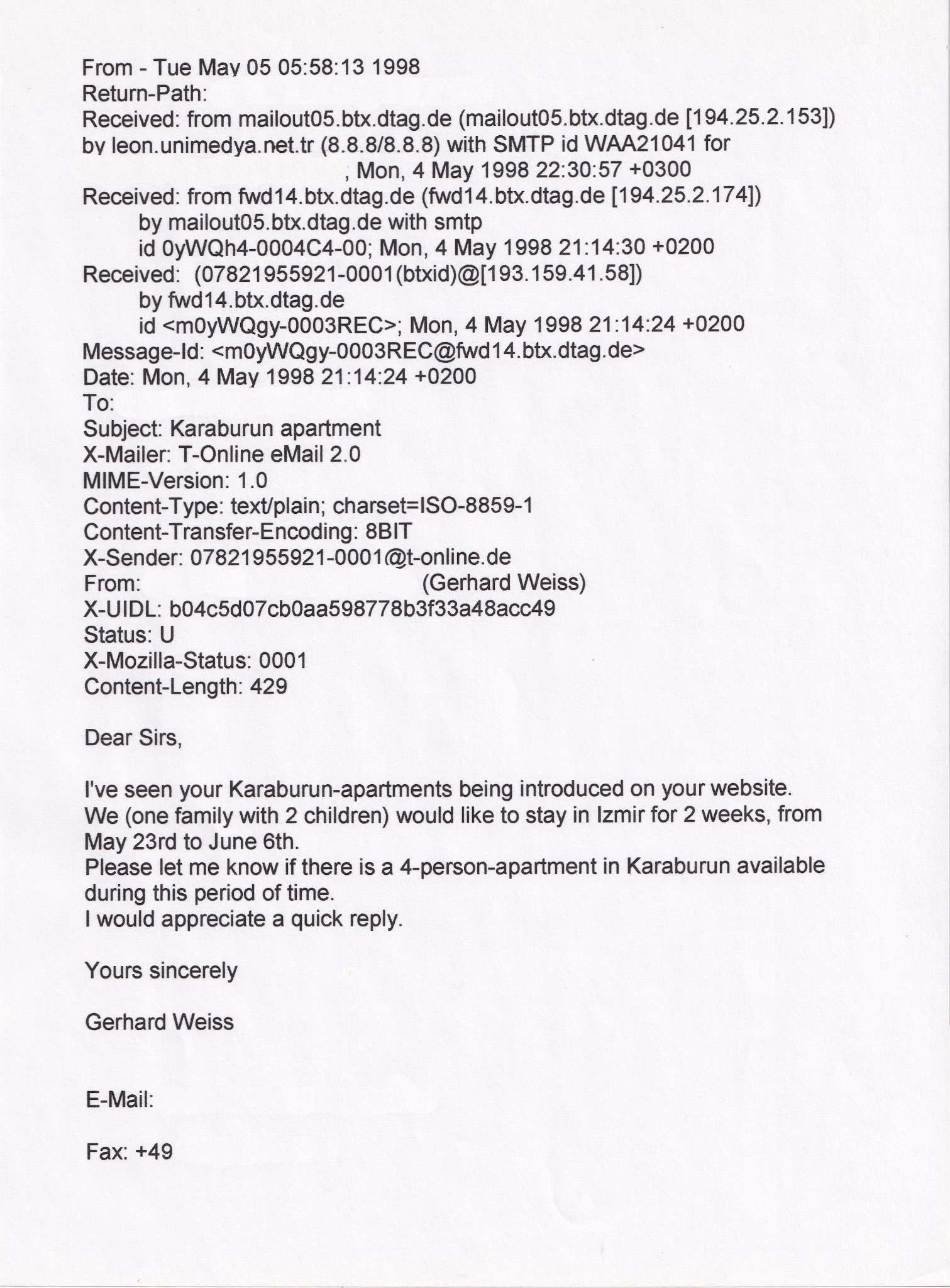
On 4 May 1998, an e-mail arrived from Gerhard Weiss in Germany. He had found Mimas Garden on the internet and asked whether a four-person apartment was available for his wife, their two children and himself for two weeks, from 23 May to 6 June.
Finding accommodation online is ordinary today, but in 1998 it was still something new. Some of Mimas Garden’s earliest guests discovered us this way. Gerhard later wrote in our guestbook that “surfing in the Internet” had been useful for his whole family and had enriched contacts between people of two different countries.
This was not the family’s first visit to Turkey. In the guestbook Gerhard wrote that they had first travelled to the country about two and a half years earlier. This time, the internet brought their path to Karaburun and to our home.
Their flight arrived at night. I met them at the airport and we travelled together to Karaburun. Gerhard later remembered that I had picked them up “in the middle of the night” and safely taken them to remote Karaburun.
Karaburun in those years was quieter and had far fewer facilities than today. Guests arriving late had very few nearby choices for shopping or eating. Depending on their arrival time, we would invite them either to dinner or to breakfast the following morning. Their first hours at Mimas Garden often began not simply with handing over a key, but by getting to know one another around the same table.
The family’s days in Karaburun were not only about the sea and a holiday. I also tried to show them the surroundings and village life. In the guestbook they described Karaburun as a quiet place to relax, a village of friendly people, and thanked me for guiding them through the village and taking them to places of traditional Turkish rural life.
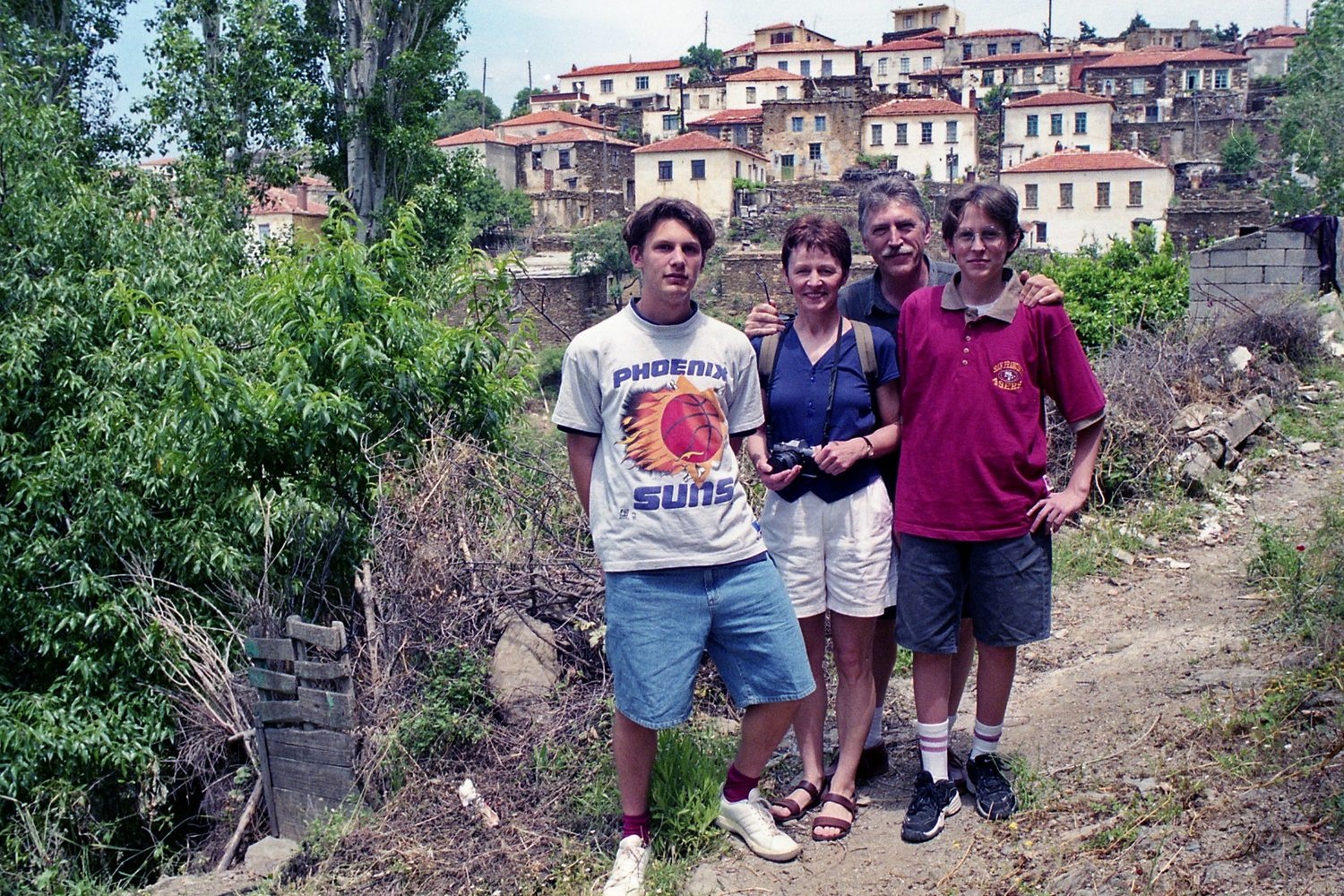
This is why the photograph chosen for this story means so much to me. It shows Gerhard and his family standing in the village with the old houses behind them. Today it preserves not only a family portrait, but also a small fragment of Karaburun in 1998.
The sea also became part of their memories. They remembered the view from their balcony and a Sunday swim near “fisherman’s rock,” in the little bay Gerhard called “your private turquoise lagoon.”
The long note Gerhard left in our guestbook is one of the most valuable documents from this visit. He wrote that the internet had enriched contacts between people from two countries, described Karaburun as a place of silence, relaxation and friendly people, and remembered our home as “a house full of hospitality.”
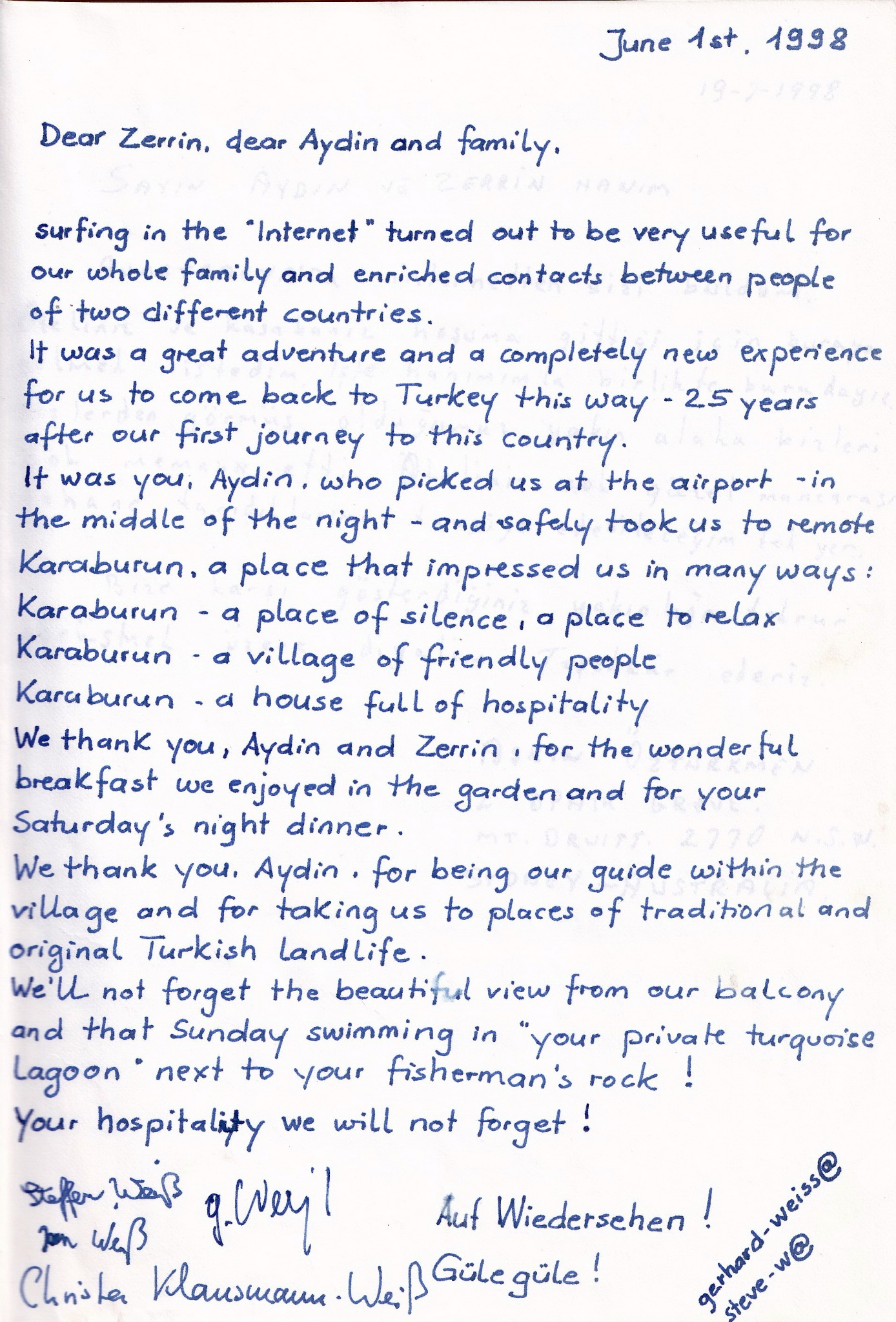
One detail that still makes me smile is that they specifically remembered the breakfast we enjoyed in the garden and our Saturday evening dinner. These were never a formal accommodation service; they were simply part of the way we welcomed people into our home.
Almost thirty years have passed. Karaburun has changed and guests now have many more places to shop and eat, but the habit of sharing a table has not completely disappeared. Last year we prepared dinner together with our Italian guests. This year we sat down one evening and shared wine with our French guests. For me, seeing those small gatherings from 1998 continue in different forms is one of the things about Mimas Garden that has remained unchanged.
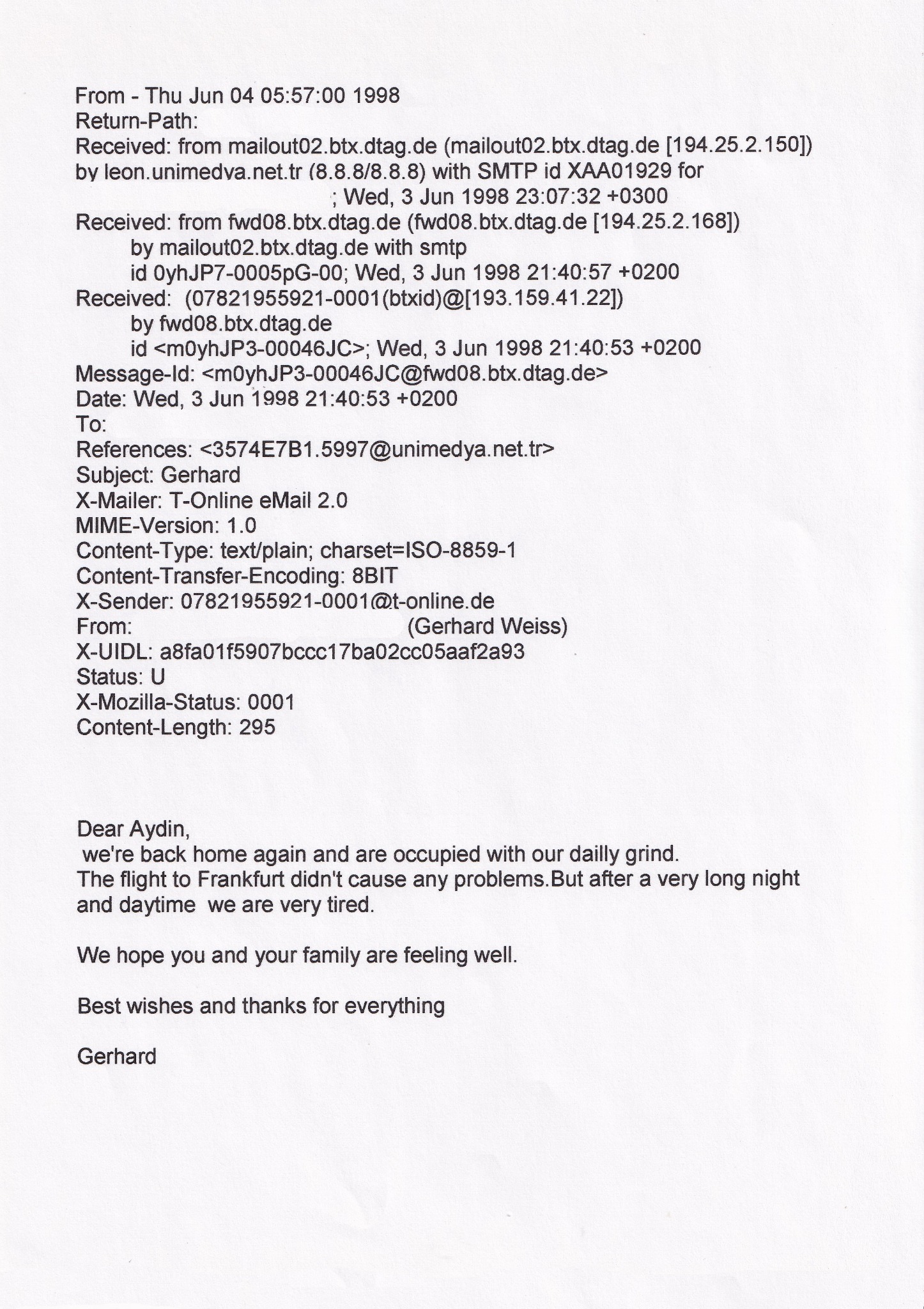
After leaving Karaburun, Gerhard added one final document to the story. On 3 June 1998, after returning to Germany, he sent another e-mail. He wrote that the flight to Frankfurt had gone smoothly, that they were very tired after a long night and day, wished our family well, and ended simply: “thanks for everything.”
Reading these documents again today, what interests me most is what Gerhard wrote about the internet in 1998. He saw it not only as useful for his family, but as something that could enrich relationships between people living in two different countries.
The internet has changed completely since then. Reservations are made with a few taps, and maps, reviews and photographs reveal almost everything before a journey begins. Yet Gerhard’s thought still feels true to me. Technology brings us into contact; what remains is the human relationship we build afterwards.
Gerhard and his family found Mimas Garden on the internet in 1998. I met them at the airport in the middle of the night. We travelled to Karaburun together, explored the village, they swam in the sea, and we sat around the same table. Twenty-eight years later, when I look at what remains, I think this is the real value of the archive: not simply where our guests stayed, but which small memories they carried away with them.