The email I still have from Paul Heraty is dated 22 August 1998. Paul, Mary Craig and Georgia were travelling from Vancouver, Canada. Yet this message did not come from Canada: Paul sent it from an internet café somewhere in the middle of England.
Before coming to Karaburun, they planned to spend a few days in Istanbul. They would fly to Istanbul on 1 September and expected to continue to İzmir on 3 September before coming to Mimas Garden. At first they hoped to stay from 3 to 7 September; if they decided to spend an extra day in Istanbul, Paul wrote that their Karaburun stay would instead be from 4 to 8 September.
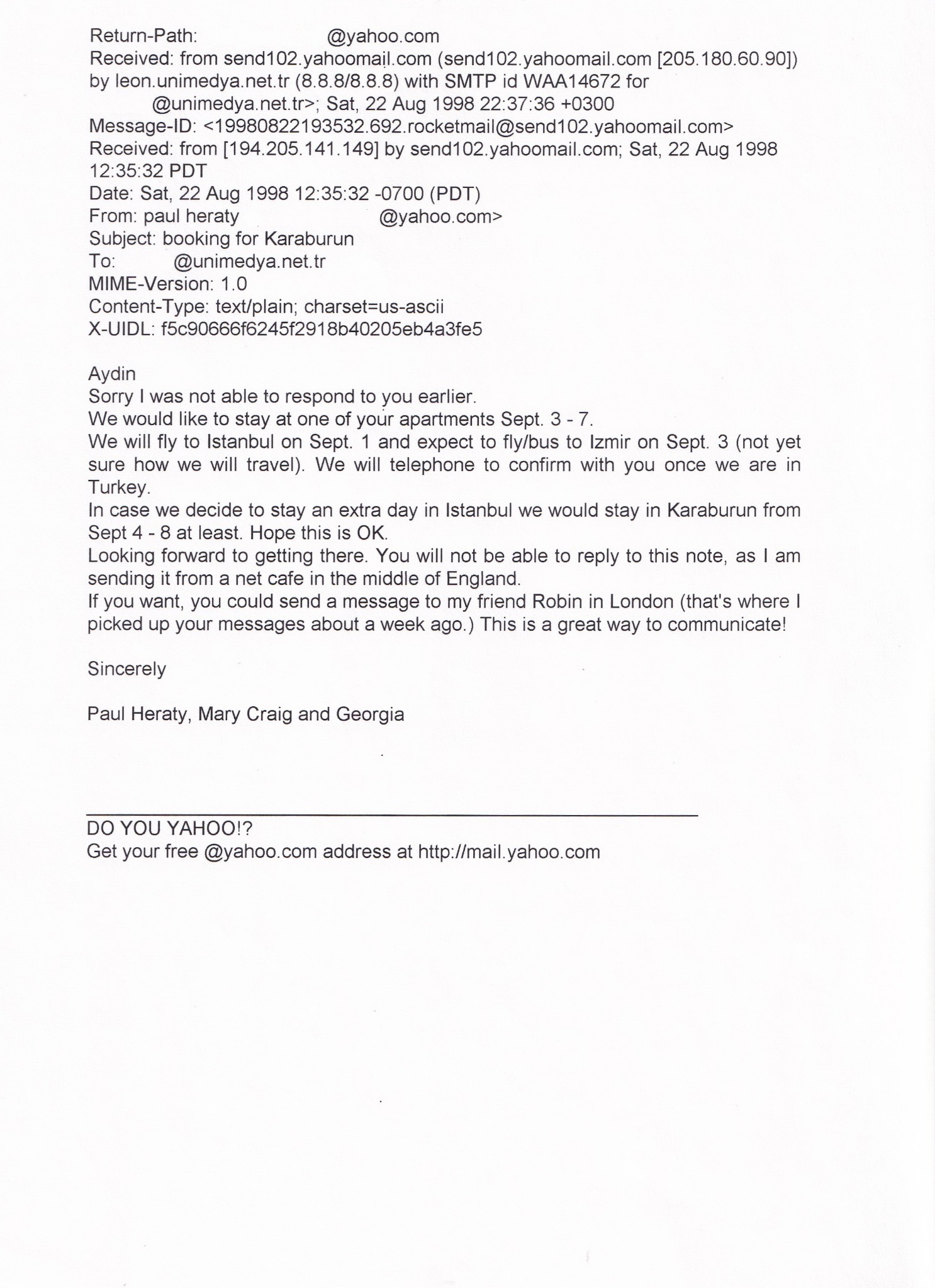
Reading the email again today, what strikes me most is the way we communicated in those years. Paul explained that I would not be able to reply directly because he was sending the message from an internet café. He had picked up our earlier messages about a week before through his friend Robin in London, and suggested that, if necessary, we could send another message to Robin.
At the end he added a sentence that sounds ordinary today, but says a great deal about 1998:
“This is a great way to communicate!”
The internet had not yet become an ordinary part of everyday life. A family travelling from Vancouver received our messages through a friend in London and confirmed their stay in Karaburun from an internet café in the middle of England. This was also how some of the earliest guests of Mimas Garden found their way to us.
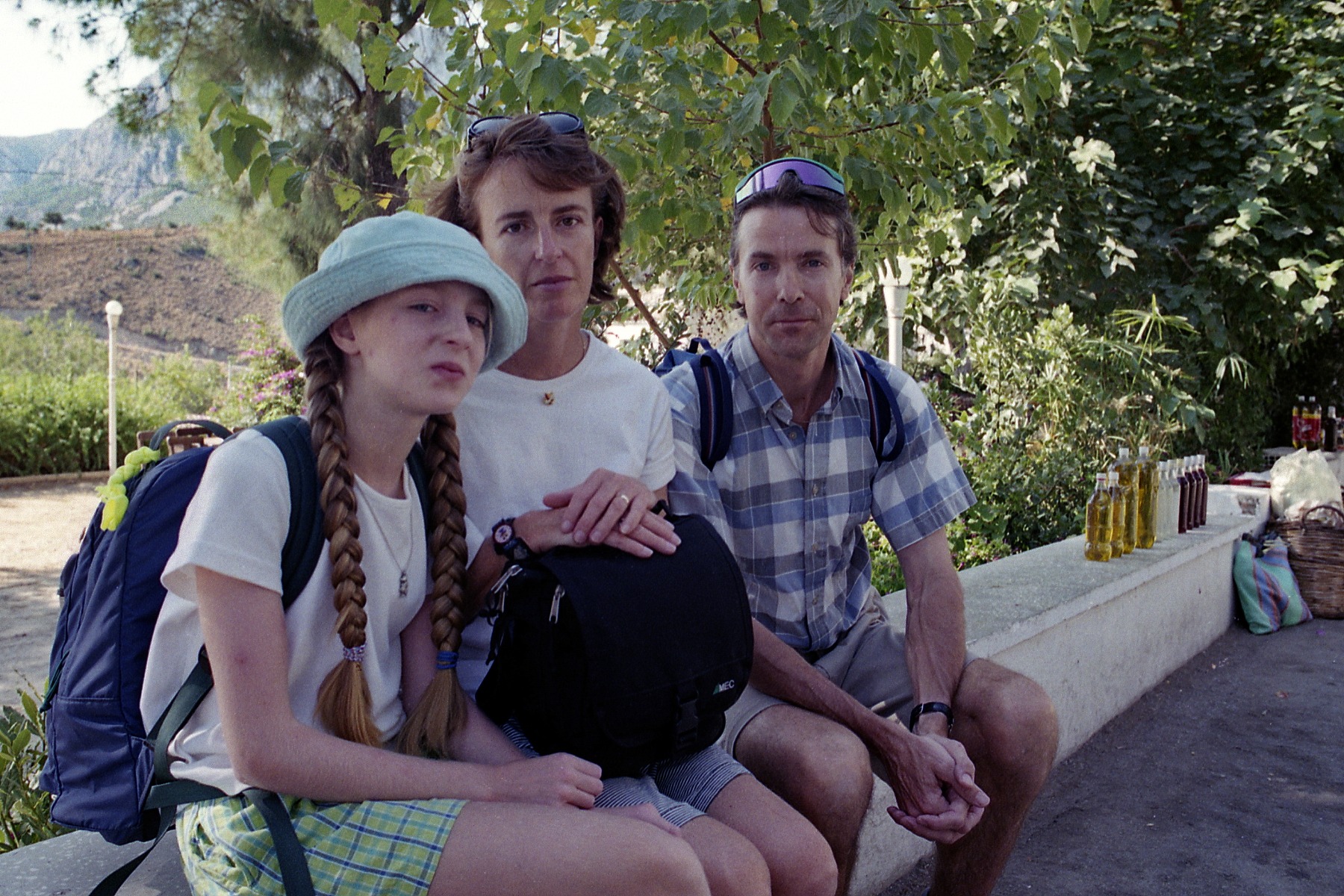
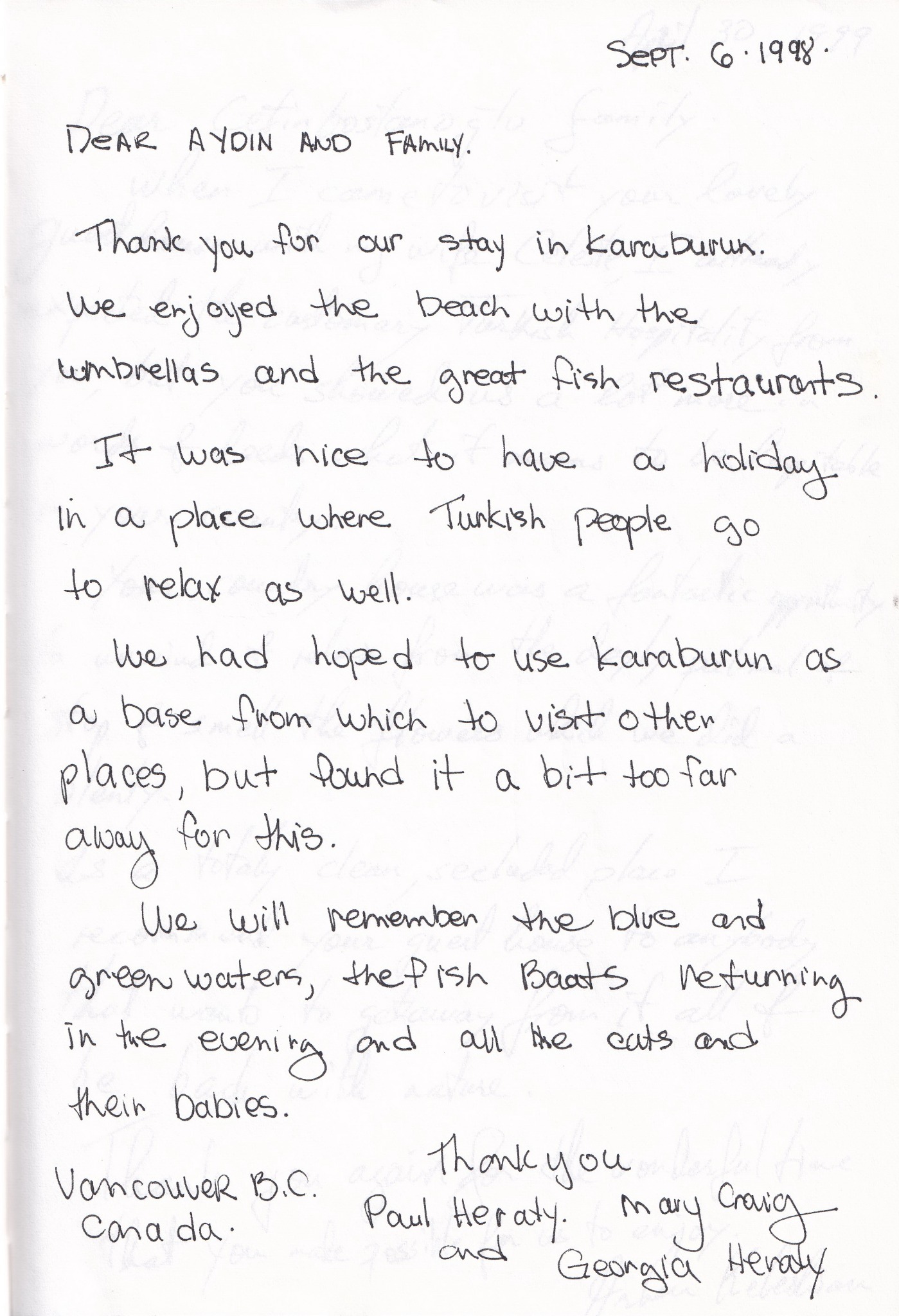
Paul, Mary and Georgia arrived in Karaburun a few days later. The note they left in our guestbook is dated 6 September 1998.
What they remembered was not a list of major sights, but small details of everyday life. They enjoyed the beach with its umbrellas and the fish restaurants. One sentence is especially meaningful to me today: they liked having a holiday in a place where Turkish people came to relax as well.
That also describes Karaburun in those years. It was not a resort created for foreign visitors. Our guests were joining the everyday life of a small coastal town where we lived and where people from Turkey came in summer to swim and relax.
They had also hoped to use Karaburun as a base from which to visit other places, but during their stay they found that it was a little too far away for that.
This detail reminds me of the Holthuis family, who stayed with us in the same year. Karaburun’s quietness and its distance from the city were among the reasons to come here, but the same qualities could become a disadvantage for guests who wanted to travel elsewhere every day.
In the end, Paul and his family seem to have remembered Karaburun less as a base for reaching other places and more as a place worth experiencing in itself.
The final lines of their guestbook entry are my favourite part.
They listed what they would remember after leaving Karaburun: the blue and green waters, the fishing boats returning in the evening, and all the cats and their babies.
They are very small images of Karaburun in 1998. Yet it is often details like these that bring a period back to life many years later: fishing boats returning from the sea in the evening, restaurants along the shore, umbrellas on the beach and cats wandering through the streets.
Only two weeks separate Paul’s email from an internet café in England on 22 August 1998 and the guestbook note they wrote in Karaburun on 6 September.
In the first, I see a family still planning its journey. They had not even decided exactly how they would travel from Istanbul to İzmir; they were working out which day they would reach Karaburun and enjoying the novelty of communicating through the internet.
In the second, they were preparing to leave Karaburun. In those few lines there is no mention of flights or the difficulties of travel. What they expected to remember was much simpler:
The blue and green colours of the sea, the fishing boats returning in the evening, and the cats of Karaburun with their kittens.
Twenty-eight years later, reading these documents again, I can see something of what the Mimas Garden guest archive means to me. People reached Karaburun from different parts of the world, sometimes by quite complicated routes. Yet the memories they carried away were often the smallest and simplest images of everyday life.